
Secret in the Movies (1959)
Doris Day first found fame as a singer in the late 1930s and
transitioned into becoming one of the biggest box office draws in film in the
50s and 60s. She made many good movies,
a handful of great ones, and others that were just trifles. Competently made, but quickly forgettable.
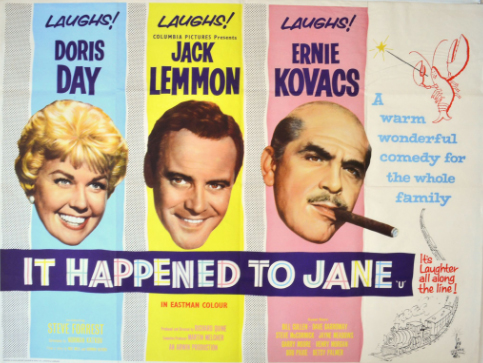
One such trifle was It Happened to Jane (1959). In it, Day plays Jane (i.e. the one “it happened to”), a Maine lobster farmer whose business is dependent on the local locomotive to get its shipments out. When an error by the train company puts her business in peril, Jane sues the railroad and earns the wrath of its owner (Ernie Kovacs, embracing his evil role so much that he practically twirls his moustache). Jack Lemmon plays her friend and lawyer and eventual love interest. Steve Forrest plays a news reporter and romantic rival who doesn’t stand a chance against the higher-billed Lemmon.
One of the things that distinguished this trifle from other
silly romantic comedies of the day was a small but delightful parade of cameos
by familiar faces from the world of television.
When Jane needs to drum up publicity for her plight, she travels to New
York City and appears on several programs. Among the people she meets are Dave
Garroway, the legendary original host of The Today Show, here hosting
the fictional The Left Hand; Bob Paige, host of The Big Payoff;
and Steve McCormack, the (real but forgotten) moderator of the (real but
forgotten) public affairs series Youth Wants to Know. Earlier in the film, Gene Rayburn, who would
become famous as the host of The Match Game and other game shows,
appears as a television reporter back in Maine. Rayburn’s role was a bit
meatier than the other cameos. Still, Rayburn,
who was already familiar to the public as a radio and television personality,
chose to go uncredited for his appearance. Decades later, he admitted
regretting that decision.
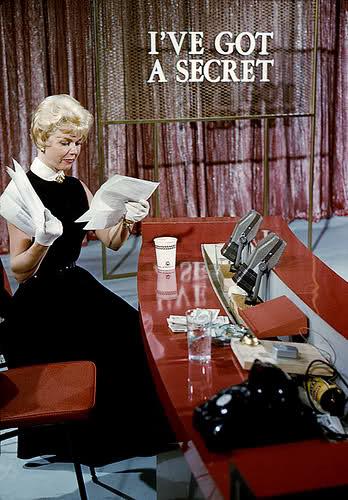
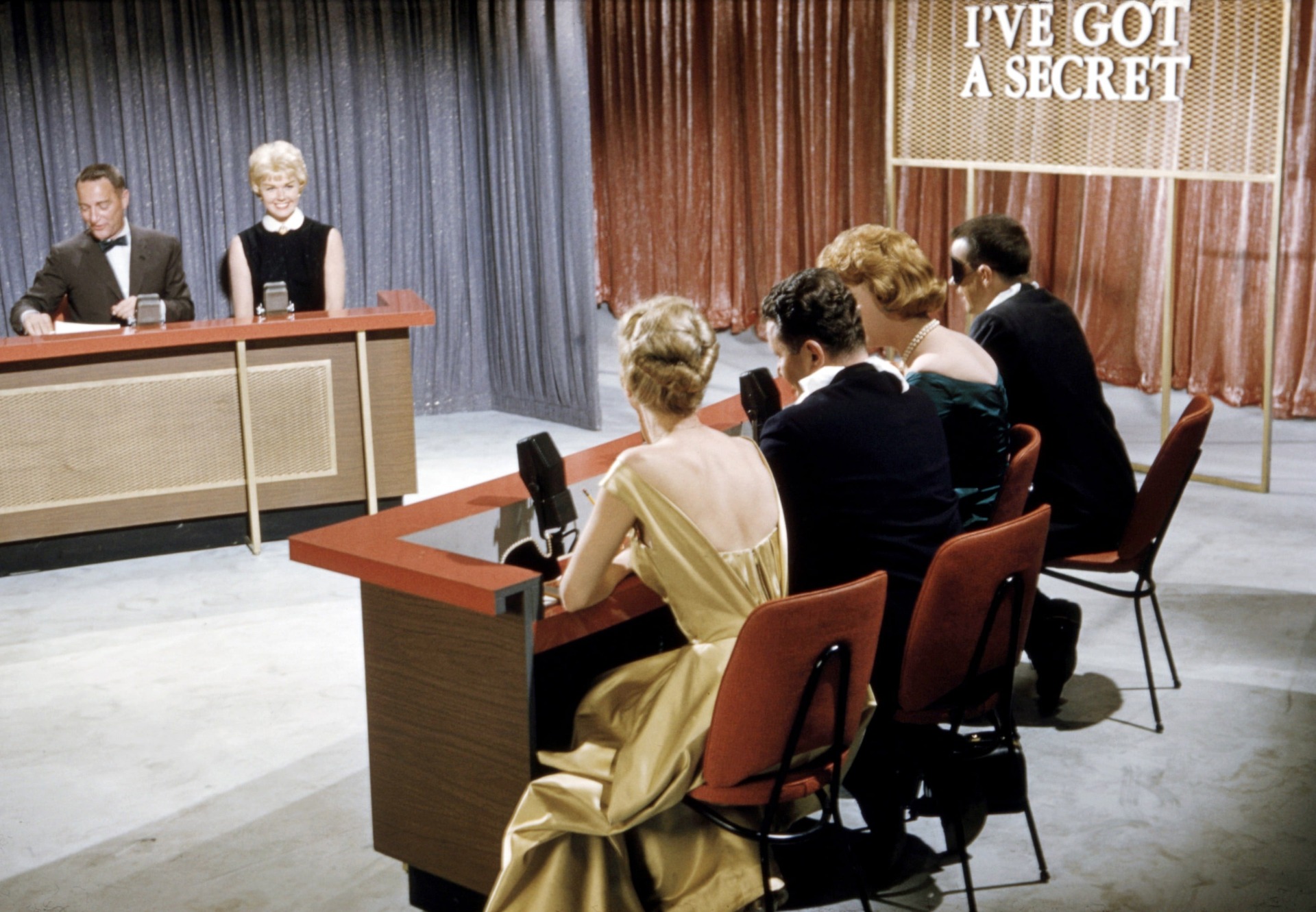
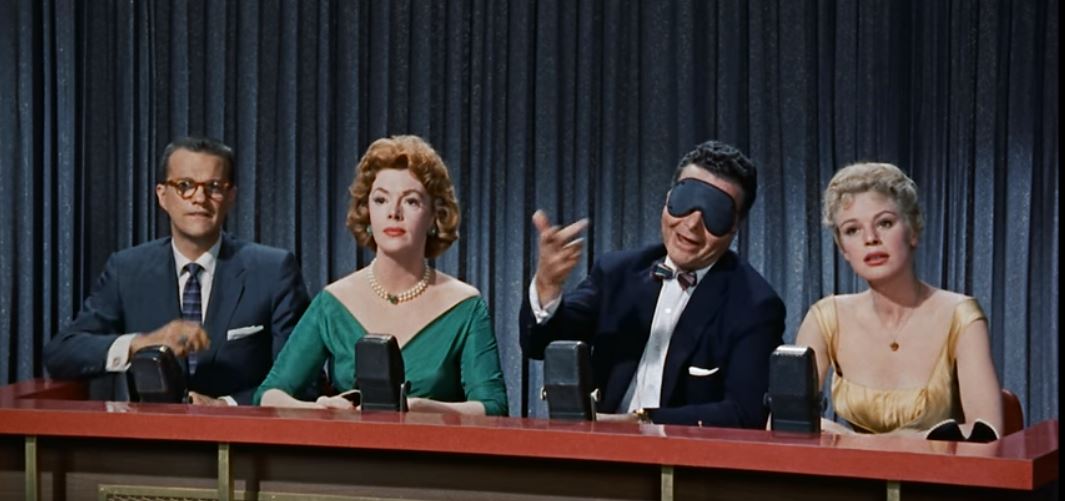
Then, of course, there was Secret. Garry, Bill, Jayne, Henry and Betsy all played themselves in an extended cameo, what amounted to a game featuring Jane as a contestant. Her secret: “I’m fighting the meanest man in the world.” The scene is only a couple minutes long, and only Garry really has much to do. The panel is seen only fleetingly. The action switches between the studio and the home of the rail baron, who’s watching the live show and plotting his next move. Delightfully, the moments that take place in the TV studio are shot in color. It’s the only moving image we have of the show in color, albeit a fictional version of it. The evil mogul at home watched the show in black and white, which would have been accurate for the time. Even though a man of his means could easily have afforded a color television set in 1959, Secret was not broadcast in color until its final season in 1966.
The Secret gang seemed mostly bemused by the glacial pace at which moviemaking took place. Jayne said, “This is the first time I’ve ever done factory work in evening clothes.” Garry said, “This is ridiculous. We could have shot four TV shows in this time and be sitting back collecting those residuals.” Garry also noted, “They’re shooting this picture so slowly that by the time it’s released, I’ve Got a Secret will probably have been off the air for years.” While that exaggerated prediction proved wrong, it’s worth noting that by the time the movie came out eight months later, Jayne was no longer a regular panelist.
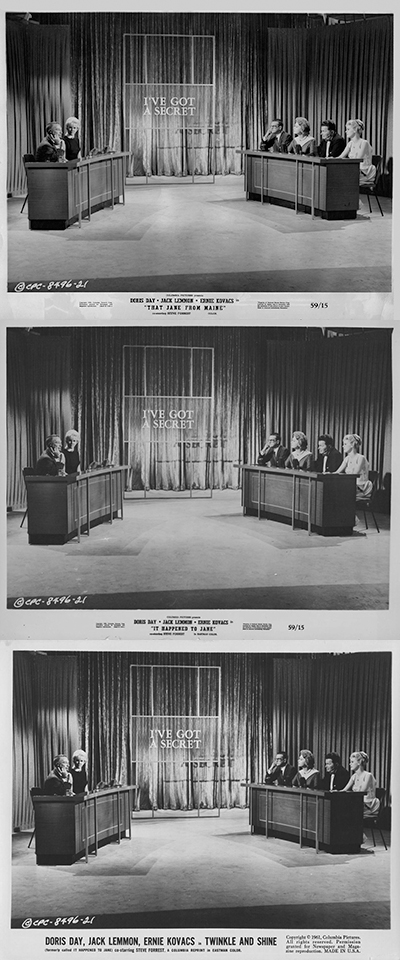
One lobby card. Three titles.
The film’s biggest existential crisis was deciding what to
call itself. They went through at least five
distinct titles over the course of production.*
In November of 1957, newspapers first reported that Doris Day had been
signed to a film called The Wreck of the Old 97. By the time production
began in mid-1958, the title had changed to Miss Casey Jones. A newspaper story in August about the Secret team’s participation still used the Miss Casey Jones title, but already
the studio had decided the movie would be released as The Jane from Maine,
later emphatically tweaked to That Jane from Maine. In what should have been the final change,
the film was released in 1959 as It Happened to Jane. But there would be one more. When the film failed to make much of an
impression at the box office, the studio thought they could rerelease it on an
unsuspecting public two years later with a different title. That second time in theaters it was called Twinkle
and Shine. Over the course of the process,
Doris Day ended up recording not one
, not two, but three different title songs for the same movie.
Incidentally, the parade of titles continues when you count
the usual retitling for international releases, many much more interesting and
descriptive than the generic American choices.
They include (translated back into English) Mexico’s The Indominable
Woman and the Millionaire, Norway’s Lobster Love and our favorite,
France’s Love, Lobsters and the Train. They also included Germany’s Not With Me, Gentlemen and
Denmark’s He, She and Him, so yeah, there were even more generic titles
available.
While both Doris Day and Jack Lemmon were already stars,
both saw their profiles increase greatly in 1959. Just not for this. In that year, Day made Pillow Talk and
Lemmon made Some Like It Hot, two films considered comedy classics even
today. Both earned Academy Award
nominations for those roles, and both firmly established themselves as A-list
stars, almost certainly the reason why the studio took the unusual step of
rereleasing the movie in 1961 under the Twinkle and Shine title.
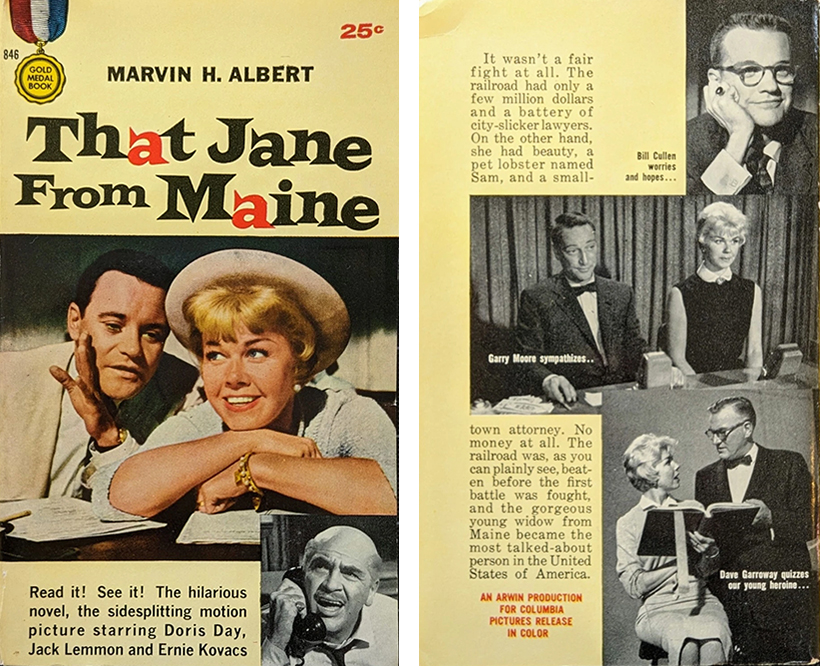
A novelization of the film came out in 1959 under the title
“That Jane from Maine.” That paperback
was based on an earlier version of the screenplay in which Jane appears on What’s
My Line? instead. She also is
acknowledged from the audience on The Ed Sullivan Show, a scene which
did not happen in the film. Oddly, the back cover of the book has photos of
Bill Cullen and Garry Moore, the latter clearly on the Secret set with
Day. In the book, the two are only mentioned in passing, and Secret is
not mentioned at all.
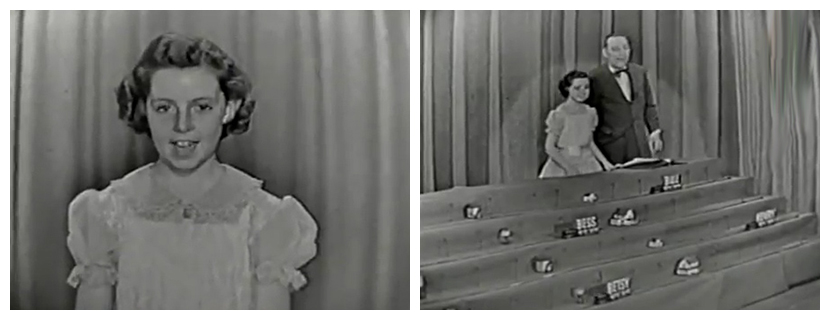
To publicize the release of the film, and to draw attention to the show’s role in it, Doris Day was to have appeared as a guest on the actual I’ve Got a Secret on May 13, 1959 ( E335 ). The show had even come up with a game for Day to play involving model trains. However, she became ill during her publicity tour and had returned home to Los Angeles. In the show-must-go-on tradition that carried Secret through many such near-disasters, the show found a 10-year-old New Jersey girl to take her place. That girl’s name was Doris Day.
*Other working titles we’ve heard about but haven’t been able to verify include Old 97 Goes to Market and As Jane Goes (So Maine Goes).